|
Product Information |
|
Product name |
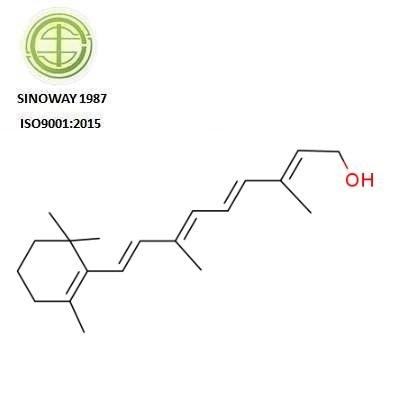
RETINOL PL 50; RETINOL; Vitamin A |
|
CAS No. |
68-26-8 |
|
Molecular Formula |
C20H30O |
|
Molecular Weight |
286.458 |
|
Quality Standard |
42.75%-49.5%; 10% up by HPLC |
|
Appearance |
Pale yellow to brownish-red |
|
COA |
|
Test Items |
Specifications |
Results |
|
Appearance |
Pale yellow to brownish-red |
Pale yellow |
|
Identification |
The retention time of the major peak of the Sample Confrms solution corresponds to the Standard solution as obtain in the assay |
Conforms |
|
Purity |
≤95% |
100% |
|
BHT |
3.15% ~3.50% |
3.42% |
|
BHA |
0.90% ~1.10% |
0.98% |
|
Assay |
42.75% ~49.50% |
46.42% |
|
Conclusion |
It conforms to Enterprise Standard |
|
|
Usage |
Retinol, also known as Vitamin A Alcohol, is the foundational molecule in the retinoid family. In skincare, it undergoes a two-step enzymatic conversion on the skin: Retinol → Retinaldehyde → Retinoic Acid. It is the final Retinoic Acid that binds to nuclear receptors (RAR/RXR) to modulate gene expression, driving collagen production and cellular turnover.
Retinol is clinically recognized as the "gold standard" for anti-aging due to its multi-faceted biological activity:
1. Anti-Wrinkle & Photoaging Repair: Upregulates Type I & III Collagen synthesis while inhibiting Matrix Metalloproteinases (MMPs) that degrade the extracellular matrix. Visible reduction in fine lines typically occurs over weeks to months of consistent use.
2. Skin Texture Refinement: Accelerates epidermal cell turnover, resulting in smoother skin and reduced roughness.
3. Even Skin Tone & Hyperpigmentation: Facilitates the shedding of melanin-containing keratinocytes and modulates melanogenesis pathways, effectively addressing sunspots and uneven tone.
China has transitioned from a follower to a leader in the global Vitamin A (VA) market, offering distinct advantages for cosmetic manufacturers sourcing Retinol:
1. High-Barrier Synthesis & Global Scale
Vitamin A is characterized by one of the longest synthetic routes among vitamins, creating significant technical barriers. Chinese producers (e.g., NHU, ZMC) have achieved global-scale capacity, positioning themselves alongside legacy Western giants like DSM and BASF.
2. Integrated Upstream Control
The true competitive moat lies in the control of critical precursors, specifically Citral and Beta-Ionone.
(1) Backward Integration: Leading Chinese firms utilize an integrated model stretching from basic petrochemical feedstocks to high-purity Retinol.
(2) Cost Efficiency: Domestic mastery of Citral synthesis (led by players like Wanhua) ensures supply security and cost-competitiveness against global volatility.
3. Maturation of Cosmetic-Grade Retinol Production
While historically dominated by imports, the market now sees robust domestic alternatives meeting stringent cosmetic standards:
(1) High Purity: Capability to produce All-trans-Retinol with controlled isomer profiles and low peroxide values.
(2) Stabilization Technology: Advanced delivery systems (encapsulation/liposomal) are now industrialized locally to ensure stability against oxidation and light.
4. Ecosystem Synergy
Proximity to the world’s largest cosmetic manufacturing hubs (Guangzhou, Shanghai, Hangzhou) allows for rapid formulation support, stability testing collaboration, and efficient logistics for bulk cosmetic raw materials.

Sinoway was established in 1987, and is specialized in research, development, custom manufacturing and trading of pharmaceutical APIs, Intermediates, health & food supplements, cosmetic raw materials, herbal extracts, FDFs and custom service all over the world.


 IPv6 network supported
 English
 中文
中文 français
 Deutsch
 русский
 español
 português
 العربية
 日本語
日本語 한국의
한국의 Türkçe