|
Product Information |
|
Product name |
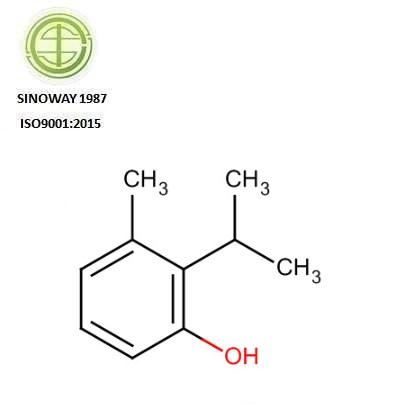
O-Cymen-5-Ol; 4-Isopropyl-3-methylphenol; 3-Methyl-4-isopropylphenol; 3-methyl-4-propan-2-ylphenol; p-Thymol; IPMP |
|
CAS No. |
3228-02-2 |
|
Molecular Formula |
C10H14O |
|
Molecular Weight |
150.22 |
|
Quality Standard |
99.99% up by HPLC |
|
Appearance |
White or almost white crystals, having almost no odor |
|
COA |
|
Test Items |
Specifications |
Results |
|
Appearance |
White or almost white crystals, having almost no odor |
Conforms |
|
Identification |
Triturate sample with an equal amount of camphor: the mixture liquefies. |
Conforms |
|
Dissolve a small sample in 1ml of glacial acetic acid, add 6 drops of sulfuric acid and 1 drop of nitric acid: a red-brown color develops. |
Conforms |
|
|
To 1g sample add 5ml of a solution of sodium hydroxide(1-> 10), and heat on a water bath: a colorless or light yellow liquid is obtained. To this liquid add 2 to 3 drops of chloroform, while warm, and shake: a yellow-green color develops |
Conforms |
|
|
The sample solution exhibits a maximum absorbance at the wavelength at 279±2 nm |
Conforms |
|
|
Assay by HPLC |
≥ 99.9% |
99.99% |
|
Melting Point |
110-113°C |
111.5-111.6°C |
|
Purity |
Clarity of solution: Dissolve 3.0g sample in 1Oml of ethanol, the solution is clear |
Conforms |
|
Organic impurities: TLC |
Conforms |
|
|
Heavy metal(Pb) ≤20ppm |
< 20ppm |
|
|
Arsenic ≤ 2ppm |
<2ppm |
|
|
Conclusion |
It conforms to the standard. |
|
|
Usage |
4-Isopropyl-3-Methylphenol (o-Cymen-5-ol) | CAS 3228-02-2
Product Overview
4-Isopropyl-3-Methylphenol, internationally recognized as o-Cymen-5-ol (INCI Name) or 3-Methyl-4-isopropylphenol, is a high-performance phenolic antimicrobial agent.
1. Global Regulatory Compliance (Reduce Time-to-Market)
Navigating international regulations is complex; our documentation simplifies the process:
(1) EU Compliance: Meets SCCS (Scientific Committee on Consumer Safety) standards. Approved for leave-on products up to 0.1% and rinse-off products at higher concentrations.
(2) Japanese Quasi-Drug: Fully compliant with Japanese PMDA standards for quasi-drug applications, making it ideal for cosmeceutical lines.
2. Superior Formulation Versatility
Designed for modern multi-format product lines (Supplements, Beverages, Cosmetics):
(1) Broad pH Stability: Effective within a pH range of 4.0–8.0, ensuring compatibility with acidic beverages and alkaline cosmetic bases.
(2) Low Odor Profile: Unlike Thymol or Carvacrol, IPMP is virtually odorless, eliminating the need for expensive masking agents in sensitive formulations like oral care or fine fragrances.
(3) Active Compatibility: Stable when combined with botanicals, peptides, and vitamins. Particularly synergistic with Berberine HCL for topical acne treatments or Niacinamide for sebum-control formulations.
3. Cost-Efficiency & High Performance
Optimize your formulation budget without sacrificing efficacy:
(1) Low Usage Rate: Effective antimicrobial activity at concentrations as low as 0.05%–0.5%.
(2) Reduced Irritation: Significantly lower sensitization potential compared to traditional phenolic preservatives, reducing the need for soothing additives in finished products.
4. Market Trend Alignment
Capitalize on high-growth consumer trends:
(1) Clean Beauty: Meets the demand for synthetic preservative alternatives in the US and European markets.
(2) Oral Care: Proven efficacy against oral malodor and gingivitis-causing bacteria.
(3) Pet Care: Increasingly used in premium pet shampoos and dental chews for biofilm control.
Target Applications
Skincare: Anti-acne serums, facial cleansers, deodorants, and sunscreen lotions.
Oral Care: Toothpaste, mouthwash, and breath sprays.
Personal Care: Baby wet wipes, intimate washes, and body sprays.
Hair Care: Anti-dandruff shampoos.
Functional Beverages: Shelf-stable juices and drink mixes.
Pet Care: Medicated shampoos and oral hygiene gels.

Sinoway was established in 1987, and is specialized in research, development, custom manufacturing and trading of pharmaceutical APIs, Intermediates, health & food supplements, cosmetic raw materials, herbal extracts, FDFs and custom service all over the world.


 IPv6 network supported
 English
 中文
中文 français
 Deutsch
 русский
 español
 português
 العربية
 日本語
日本語 한국의
한국의 Türkçe