|
Product Information |
|
Product name |
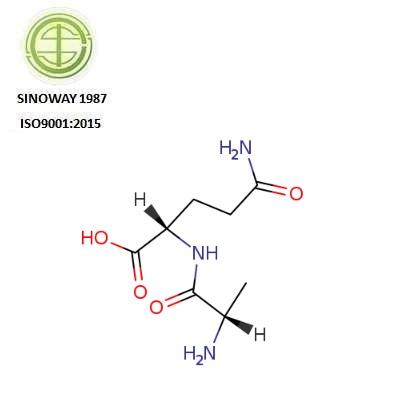
L-Alanyl-L-Glutamine; Alanyl Glutamine; L-Ala-L-Gln; Ala-Gln |
|
CAS No. |
39537-23-0 |
|
Molecular Formula |
C8H15N3O4 |
|
Molecular Weight |
217.225 |
|
Quality Standard |
98.5% up by HPLC |
|
Appearance |
White to almost-white crystal or crystalline powder |
|
COA |
|
Test Items |
Specifications |
Results |
|
Appearance |
White to almost-white crystal or crystalline powder |
White crystalline powder |
|
Specific optical rotation |
+9.5°~ +11.0° |
+10.6° |
|
ID(Physico-chemical) |
Positive |
Conforms |
|
Identification(IR) |
The IR spectrum of the sample corresponds to the IR spectrum of the RS |
Conforms |
|
pH |
5.0 ~6.0 |
5.7 |
|
Appearance of solution |
Not more opalescent than reference suspension 1 |
Conforms |
|
Not more intensely coloured than reference solution Y1 |
Conforms |
|
|
Chlorides |
≤0.02% |
Conforms |
|
Sulphates |
≤ 0.02% |
Conforms |
|
Ammonium salt |
≤ 0.08% |
Conforms |
|
Loss on Drying |
≤ 0.5% |
0.25% |
|
Sulphated Ash |
≤ 0.1% |
0.05% |
|
Iron |
≤ 10ppm |
Conforms |
|
Heavy metals |
≤ 10ppm |
Conforms |
|
Arsenic(AS2O3) |
≤ 1ppm |
Conforms |
|
Related substances 1 |
Impurity I ≤ 0.2% |
0.01% |
|
Impurity II ≤ 0.04% |
ND |
|
|
Impurity III ≤ 0.15% |
ND |
|
|
Impurity IV ≤ 0.05% |
ND |
|
|
Impurity V ≤ 0.05% |
ND |
|
|
Impurity VI ≤ 0.5% |
0.03% |
|
|
Any Individual unspecified impurity≤ 0.10% |
0.02% |
|
|
Methylene dichloride ≤ 600ppm |
ND |
|
|
Related substances 2 |
Impurity N ≤ 0.10% |
0.04% |
|
Impurity G ≤ 0.10% |
ND |
|
|
Impurity H ≤ 0.10% |
ND |
|
|
Impurity I ≤ 0.10% |
ND |
|
|
Impurity M ≤ 0.10% |
ND |
|
|
Assay (on the anhydrous basis) |
98.5%~101.0% |
100.8% |
|
Residual solvents |
Methanol ≤ 3000ppm |
ND |
|
Bacterial Endotoxins |
< 0.05EU/mg |
Conforms |
|
Microbial Limit |
Total aerobe ≤ 1000cfu/g |
<10cfu/g |
|
Total Yeast and Mold Count ≤ 100cfu/g |
5cfu/g |
|
|
Escherichia coli Not detected |
ND |
|
|
Conclusion |
It conforms to all the specification |
|
|
Usage |
L-Alanyl-L-Glutamine(Alanyl Glutamine) is a pharmaceutically optimized, stable dipeptide that serves as a superior delivery system for glutamine in the human body. It is specifically designed for use in clinical and therapeutic nutrition, particularly when the body is under severe metabolic stress and glutamine becomes a conditionally essential amino acid. This form solves the critical problem of free glutamine’s instability in aqueous solutions.
Core Functions and Direct Clinical Applications of L-Alanyl-L-Glutamine:
1. Provides a Stable, Bioavailable Source of Glutamine.
Primary Application: Parenteral Nutrition (PN) / Intravenous Formulations.
Mechanism & Use: The dipeptide bond protects the glutamine molecule, allowing it to remain stable in intravenous (IV) bags during heat sterilization and storage. Once infused, it is rapidly cleaved in the blood to release bioavailable L-glutamine and L-alanine. This makes it an essential component of Total Parenteral Nutrition (TPN) for patients who cannot use their gastrointestinal tract.
2. Serves as the Primary Fuel for Intestinal Lining Cells (Enterocytes).
Primary Application: Gut Health Support & Barrier Function.
Mechanism & Use: Glutamine is the preferred energy source for the cells of the small intestine. Supplementation with L-Alanyl-L-Glutamine in critically ill, surgical, or oncology patients helps maintain intestinal mucosal integrity, support gut barrier function, and may reduce the risk of bacterial translocation from the gut into the bloodstream.
3. Acts as a Crucial Metabolic Substrate for Immune Cells.
Primary Application: Immune Modulation in Critical Care.
Mechanism & Use: Lymphocytes, macrophages, and other immune cells require glutamine for optimal function, especially during times of physiological stress. Providing this dipeptide in clinical nutrition protocols helps support immune system competence in patients with sepsis, major trauma, burns, or post-operatively.
4. Improves Nitrogen Balance and Protein Metabolism.
Primary Application: Muscle Mass Preservation & Recovery.
Mechanism & Use: During severe catabolic states, the body breaks down muscle protein.
L-Alanyl-L-Glutamine helps shift the body’s nitrogen balance towards a more anabolic (building) state, reducing muscle protein breakdown (catabolism) and aiding in the preservation of lean body mass.
Key Product Advantages of L-Alanyl-L-Glutamine
1. Superior Stability: Soluble and heat-stable for reliable inclusion in parenteral formulations.
2. High Bioavailability: Efficiently hydrolyzed to release active glutamine at the target site.
3. Therapeutic Efficacy: Directly addresses glutamine deficiency in critical illness.

Sinoway was established in 1987, and is specialized in research, development, custom manufacturing and trading of pharmaceutical APIs, Intermediates, health & food supplements, cosmetic raw materials, herbal extracts, FDFs and custom service all over the world.


 IPv6 network supported
 English
 中文
中文 français
 Deutsch
 русский
 español
 português
 العربية
 日本語
日本語 한국의
한국의 Türkçe