|
Product Information |
|
Product name |
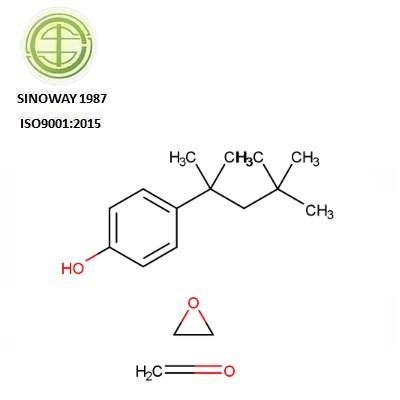
Tyloxapol |
|
CAS No. |
25301-02-4 |
|
Molecular Formula |
C17H28O3 |
|
Molecular Weight |
280.41 |
|
Quality Standard |
USP-NF2025, DMF |
|
COA |
|
Test Items |
Specifications |
Results |
|
Character |
Viscous, amber liquid, having a slight, aromatic odor. May exhibit a slight turbidity. |
Viscous, amber liquid, having a slight, aromatic odor. May exhibit a slight turbidity. |
|
Solubility |
Slowly but freely miscible in water,soluble in glacial acetic acid, in beznene, in toluene, in chloroform, in carbon-tetrachloride and carbon disulfide. |
Conforms |
|
Refractive index |
1.495~1.501(25℃) |
1.497 |
|
Infrared identification |
Infrared absorption spectrophotometry. Meets the requirements. |
Conforms |
|
UV Spectrum |
Exhibits maximum and minimum at the same wavelengths as RS |
Exhibits maximum and minimum at the same wavelengths as RS |
|
Residue on ignition |
NMT1.0% |
0.04% |
|
Limit of anionic detergents |
NMT0.075% |
<0.075% |
|
Limit of ethylene oxide |
NMT 10μg/g |
N.D |
|
Limit of formaldehyde |
NMT0.0075% |
<0.0075% |
|
Free phenol |
No cloudiness or precipitation is observed immediately |
Conforms |
|
Absence of cationic detergents |
No blue color is observed in the organic solvent layer. |
Conforms |
|
Cloud point |
Between 92℃ and 97℃ |
94℃ |
|
Water content |
NMT 1% |
0.05% |
|
Toluene |
NMT 100ppm |
0.8ppm |
|
pH(5% solution) |
4.0~7.0 |
5.8 |
|
Color value |
NMT 150 |
11 |
|
Ethylene Oxide (internal method) |
NMT 10ppm |
0.1ppm |
|
Bacterial endotoxins |
NMT 2EU/mg |
Conforms |
|
Microbial limit |
TAMC: NMT 103cfu/ml; |
<10cfu/ml |
|
TYMC: NMT 102cfu/ml; |
<1cfu/ml |
|
|
E.coli shall not be detected |
Conforms |
|
|
Storage |
Reserve in tight containers. |
|
|
Conclusion |
Meets all requirements of USP-NF2025 and Customer needs |
|
|
Usage |
Product at a Glance
Tyloxapol (CAS 25301-02-4), also known as Triton WR-1339, is a nonionic polymeric surfactant supplied as a pharmaceutical excipient. It is an oxyethylated tert-octylphenol–formaldehyde condensate used mainly as a solubiliser, emulsifier and wetting agent in ophthalmic and otic formulations and in contact lens care solutions, and as a spreading aid in synthetic pulmonary surfactant preparations. It is a pale yellow to amber clear viscous liquid, soluble in water and in common organic solvents, and has no fixed molecular weight because it is a polymer.
1. Ophthalmic formulations: solubiliser and emulsifier for poorly water-soluble actives in eye drops; helps keep the solution clear and physically stable.
2. Otic drops: wetting and solubilising aid.
3. Contact lens and orthokeratology (OK lens) care solutions: cleaning, lens wetting and lubricity that reduces lens-to-cornea friction, and removal of protein deposits from the lens surface.
4. Inhalation and pulmonary products: one of the three components of the synthetic lung surfactant Exosurf Neonatal (colfosceril palmitate, cetyl alcohol and tyloxapol), where it promotes rapid spreading and adsorption at the air–alveolar interface; also used as a wetting and dispersing aid in nebulised and aerosol formulations.
5. Preclinical research: as Triton WR-1339 it induces acute hyperlipidaemia in rodents by inhibiting lipoprotein lipase, and is a standard tool in screening lipid-lowering candidates.
6. General formulation work: solubilisation of lipophilic compounds and stabilisation of dispersions in liquid and semi-solid dosage forms.
1. What is Tyloxapol used for in pharmaceuticals?
Tyloxapol is a nonionic surfactant excipient used to solubilise and emulsify poorly water-soluble drugs in eye drops and otic drops, to clean, wet and lubricate contact lenses in care solutions, and to help synthetic pulmonary surfactants spread at the air–alveolar interface. Under the name Triton WR-1339 it is also used to induce hyperlipidaemia in preclinical research.
2. Is Tyloxapol an API or an excipient?
It is a pharmaceutical excipient, not an active pharmaceutical ingredient. It has no therapeutic claim of its own; its value is functional, as a solubiliser, emulsifier, wetting agent and spreading aid. Buyers are normally finished-dose manufacturers, contact lens solution producers and CDMOs.

Sinoway was established in 1987, and is specialized in research, development, custom manufacturing and trading of pharmaceutical APIs, Intermediates, health & food supplements, cosmetic raw materials, herbal extracts, FDFs and custom service all over the world.


 IPv6 network supported

 English
 中文
 français
 Deutsch
 русский
 español
 português
 العربية
 日本語
 한국의
 Türkçe