|
Product Information |
|
Product name |
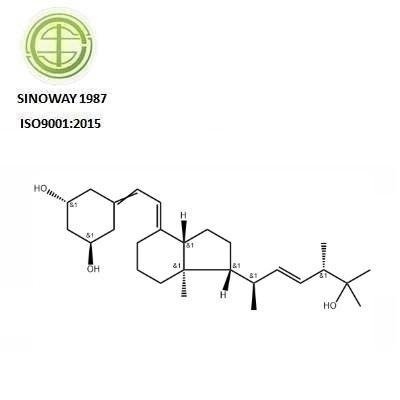
Paricalcitol |
|
CAS No. |
131918-61-1 |
|
Molecular Formula |
C27H44O3 |
|
Molecular Weight |
416.64 |
|
Quality Standard |
S.Impurity<0.05%, 99% up, PMDA, DMF |
|
Appearance |
White to almost white powder |
|
COA |
|
Test Items |
Specifications |
Results |
|
Appearance |
White to almost white powder |
White powder |
|
Identification |
(1) IR: Identical versus reference spectrum |
Conforms |
|
(2) The retention time of the major peak in the chromatogram of the assay preparation corresponds to that in the chromatogram of the standard preparation, as obtained in the Assay. |
Conforms |
|
|
Solubility |
Soluble in anhydrous alcohol, insoluble in water. |
Conforms |
|
Loss on drying |
≤ 2.0% |
0.04% |
|
Related substances (Report Threshold 0.05%) |
22Z-Paricalcitol ≤ 0.15% |
ND |
|
Any individual impurity ≤0.10% |
ND |
|
|
Total impurities ≤0.15% |
ND |
|
|
Residual solvents
|
Isopropyl acetate ≤5000ppm |
325ppm |
|
2-Propanol ≤5000ppm |
< 23.9ppm(LOD) |
|
|
Microbial limits |
TAMC ≤5 cfu/mg |
<1cfu/mg |
|
TYMC ≤5 cfu/mg |
<1cfu/mg |
|
|
E.coli: should be absence in 1mg |
Absent |
|
|
Bacterial endotoxins |
< 5 EU/μg |
< 5 EU/μg |
|
Assay (Calculated on the dried basis) |
97.0% - 103.0% |
100.0% |
|
Conclusion |
It conforms to USP2024 including in-house standard. |
|
|
Usage |
Paricalcitol (19-nor-1α,25-dihydroxyvitamin D₂; CAS 131918-61-1; C27H44O3; MW 416.64; ATC H05BX02) is a synthetic vitamin D receptor activator for secondary hyperparathyroidism in chronic kidney disease. Its advantage is not stronger PTH suppression — it is the separation of PTH suppression from calcemic and phosphatemic effects, achieved through the 19-nor A-ring modification and the retained vitamin D₂ side chain.
PTH reduction ≥30% in 91% of patients versus 13% on placebo (P < 0.001). Median time to ≥40% PTH suppression was 8 weeks versus 12 weeks for calcitriol (P = 0.02), and the therapeutic PTH range was reached at 18 weeks in patients who had never reached it on calcitriol.
Hypercalcemic episodes were 18% versus 33% on calcitriol (P = 0.008). Fractional intestinal calcium absorption was lower (0.135 vs 0.158; P = 0.022). In a two-year crossover study (n = 73), switching from calcitriol to paricalcitol at a 1:3 ratio lowered serum calcium (P = 0.0003), phosphorus (P = 0.027), Ca × P product (P = 0.003), PTH (P = 0.001) and alkaline phosphatase (P = 0.0005), with far fewer missed doses (P < 0.0001).
Oral and intravenous presentations are both marketed, covering dialysis and non-dialysis settings. A 1:3 conversion ratio applies when switching from calcitriol. Pill burden over 24 weeks was 240 versus 292 tablets (P = 0.01).
|
Endpoint |
Paricalcitol |
Comparator |
P value |
|
≥30% PTH reduction, CKD stage 3–4, 24 wk |
91% |
13% (placebo) |
< 0.001 |
|
Median time to ≥40% PTH suppression |
8 weeks |
12 weeks (calcitriol) |
0.02 |
|
Hypercalcemic episodes, dialysis |
18% |
33% (calcitriol) |
0.008 |
|
Fractional intestinal Ca absorption |
0.135 |
0.158 (calcitriol) |
0.022 |
|
Ca × P product, 2-yr crossover |
Lower |
Calcitriol baseline |
0.003 |
In non-dialysis CKD stage 3–4 patients, the difference in confirmed hypercalcemia was not statistically significant (3 vs 1 event; P = 0.36), and a small oral head-to-head dialysis trial (n = 66) found similar efficacy and safety (iPTH −48.4% vs −41.9%; P = 0.6). A 2016 systematic review concluded that the evidence is insufficient to demonstrate an advantage over non-selective vitamin D derivatives. Defensible positioning: faster attainment of the PTH target, lower intestinal calcium absorption, lower Ca × P product, lower pill burden — not a blanket claim of superiority.

Sinoway was established in 1987, and is specialized in research, development, custom manufacturing and trading of pharmaceutical APIs, Intermediates, health & food supplements, cosmetic raw materials, herbal extracts, FDFs and custom service all over the world.


 IPv6 network supported
 English
 中文
中文 français
 Deutsch
 русский
 español
 português
 العربية
 日本語
日本語 한국의
한국의 Türkçe