|
Product Information |
|
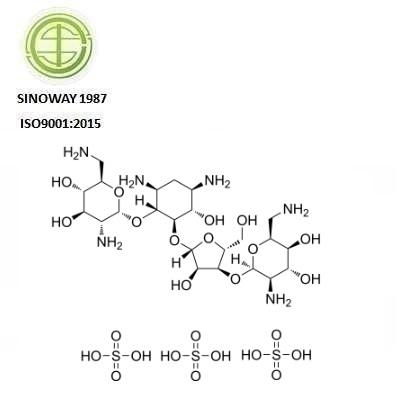
Product name |
Framycetin Sulfate; Neomycin B sulfate; Fradiomycin B sulfate |
|
CAS No. |
4146-30-9 |
|
Molecular Formula |
C23H52N6O25S3 |
|
Molecular Weight |
908.88 |
|
Quality Standard |
EP11 |
|
COA |
|
Test Items |
Specifications |
Results |
|
Appearance |
White or yellowish-white powder, Hygroscopic |
Yellowish-white powder, Hygroscopic |
|
Solubility |
Freely soluble in water, very slightly soluble in ethanol (96 per cent), practically insoluble inacetone |
Conforms |
|
Identification |
Examine the chromatograms obtained in the test for related substances. Results: -the retention time of the principal peak in the chromatogram obtained with the test solution is approximately the same as that of the principal peak in the chromatogram obtained with reference solution (a), - it complies with the limit given for impurity C. |
Conforms |
|
It gives reaction (a) of sulfates |
Conforms |
|
|
pH |
6.0 - 7.0 |
6.3 |
|
Specific optical rotation |
+52.5°~ +55.5° |
+52.6° |
|
Loss on drying |
≤8.0% |
6.5% |
|
Sulfate |
27.0% - 31.0% |
28.2% |
|
Sulfated ash |
≤1.0% |
0.6% |
|
Residual substances |
Impurity A ≤1.0% |
0.10% |
|
Impurity C ≤3.0% |
0.8% |
|
|
Total other impurities ≤3.0% |
< 1.0% |
|
|
Assay |
≥ 630 IU/mg (dried substance) |
759 IU/mg |
|
Bacterial endotoxins |
≤1.3 IU/mg |
Conforms |
|
Microbial limits |
TAMC ≤103 cfu/g |
<10cfu/g |
|
TYMC ≤10²cfu/g |
<10cfu/g |
|
|
Particle size |
D10μm |
15μm |
|
D50μm |
62μm |
|
|
D90μm |
168μm |
|
|
Conclusion |
It conforms to EP11 quality standard. |
|
|
Usage |
Framycetin Sulfate (CAS 4146-30-9)— An Aminoglycoside for Topical, Ophthalmic and ENT Formulations
Framycetin sulfate is the sulfate of neomycin B, an aminoglycoside produced by selected strains of Streptomyces fradiae or Streptomyces decaris. It is the principal and most pharmacologically active component of the neomycin complex — supplied not as a variable fermentation mixture, but as a purified single-entity API with pharmacopoeially defined composition and potency.
1. Mechanism: bactericidal and rapid
Like other aminoglycosides, framycetin binds the 30S ribosomal subunit — specifically the 16S rRNA and the S12 protein — blocking mRNA reading, inducing misreading and translational frameshift, and causing premature termination. The result is bactericidal rather than bacteriostatic activity, which is the clinically relevant property for superficial skin, wound, ocular and aural infections where bacterial load must be reduced quickly.
2. Spectrum and established clinical use
Framycetin sulfate is active against a wide range of Gram-positive and Gram-negative organisms implicated in superficial infections, including staphylococci (including strains resistant to other antibiotics), Pseudomonas aeruginosa, coliform bacteria and pneumococci. Established formulations and use concentrations:
|
Application |
Typical concentration |
Indications |
|
Skin cream / ointment |
1% |
Superficial bacterial skin infections, burns, wounds, pyoderma, impetigo, folliculitis, infected eczema and ulcers |
|
Eye drops / ointment |
0.50% |
Bacterial conjunctivitis, blepharitis, styes, corneal abrasions and burns; prophylaxis after foreign-body removal |
|
Ear / nasal (often combined) |
0.50% |
Otitis externa; used with gramicidin and dexamethasone in combination ENT preparations |
Regulatory product information for ophthalmic framycetin preparations notes that the substance is exceptionally well tolerated by ocular tissues and that the preparations are non-irritant — a relevant point for ophthalmic formulators selecting between aminoglycosides.
3. Why framycetin sulfate outperforms generic neomycin sulfate
This is the core commercial argument, and it is a composition argument, not a marketing one — which is exactly why it withstands scrutiny from QA and regulatory reviewers.
|
Dimension |
Framycetin Sulfate |
Neomycin Sulfate USP/EP |
|
Composition |
Purified single entity (neomycin B) |
Variable mixture of neomycin B, neomycin C and neamine (neomycin A) |
|
Neomycin C limit |
≤3% (Ph.Eur.) |
Not controlled to the same limit |
|
Neomycin A (neamine) limit |
≤1% |
Present as a constituent |
|
Potency basis |
≥630 IU/mg (dried substance) |
Expressed against the mixed complex |
|
Relative activity |
Neomycin B is the most active stereoisomer; supplier and aminoglycoside literature reports roughly 65% greater activity than neomycin C and about 90% greater than neomycin A |
Diluted by less active stereoisomers |
|
Batch-to-batch reproducibility |
Composition defined, so potency is reproducible |
Stereochemical variability translates into variable antimicrobial performance |

Sinoway was established in 1987, and is specialized in research, development, custom manufacturing and trading of pharmaceutical APIs, Intermediates, health & food supplements, cosmetic raw materials, herbal extracts, FDFs and custom service all over the world.


 IPv6 network supported
 English
 中文
中文 français
 Deutsch
 русский
 español
 português
 العربية
 日本語
日本語 한국의
한국의 Türkçe