|
Product Information |
|
Product name |
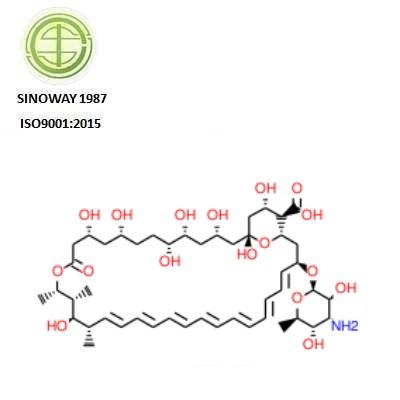
Amphotericin B |
|
CAS No. |
1397-89-3 |
|
Molecular Formula |
C47H73NO17 |
|
Molecular Weight |
924.08 |
|
Quality Standard |
CEP/EP |
|
Appearance |
Yellow to orange powder |
|
COA |
|
Test Items |
Specifications |
Results |
|
Appearance |
Yellow to orange powder |
Yellow powder |
|
Identification |
Conforms to standard; absorbance in the range of 240 to 320nm. |
Conforms |
|
Conforms to standard; absorbance in the range of 320 to 400nm. |
Conforms |
|
|
Loss on drying |
≤5.0% |
0.8% |
|
Residue on ignition |
≤0.5% |
0.2% |
|
Limit of amphotericin A |
≤5%, calculated on the dried basis |
ND |
|
Assay |
≤750μg/mg, calculated on the dried basis |
1090μg/mg |
|
Microbiological Examination |
||
|
Total Aerobic Count |
≤100CFU/gram |
Conforms |
|
Salmonella Species |
Negative |
Conforms |
|
Escherichia Coli |
Negative |
Conforms |
|
Bacterial Endotoxins |
≤0.9 EU/mg |
Conforms |
|
Residual Solvents |
||
|
Ethano |
≤5000 ppm |
712 ppm |
|
DMF |
≤6000 ppm |
2285 ppm |
|
Acetone |
≤5000 ppm |
1128 ppm |
|
Triethylamine |
≤2000 ppm |
ND |
|
Conclusion |
It conforms to current USP |
|
|
Usage |
Amphotericin B (AmB) is a polyene antifungal discovered in the 1950s. It remains a cornerstone therapy for life-threatening invasive fungal infections (IFD) due to its unique mechanism and broad spectrum.
Target: Fungal cell membrane ergosterol.
Process: Binds to ergosterol and creates transmembrane pores.
Result: Leakage of intracellular ions (K⁺, Na⁺, Mg²⁺) leading to rapid fungicidal (killing) activity.
Selectivity Issue: It also binds weakly to mammalian cholesterol, which explains its dose-limiting toxicity profile.
Amphotericin B covers nearly all clinically relevant fungal pathogens:
✅ Yeasts: Candidaspecies (high susceptibility).
✅ Cryptococci: Cryptococcus neoformans.
✅ Molds: Aspergillusspecies.
✅ Mucormycosis: Rhizopusand Mucorspecies (Critical Indication).
✅ Endemic Fungi: Histoplasma, Coccidioides, Blastomyces.
Compared to Azoles (e.g., Fluconazole, Voriconazole) and Echinocandins (e.g., Caspofungin):
Feature

Amphotericin B is the definitive therapy in specific high-mortality situations:
1. Mucormycosis: The only reliable first-line treatment. Azoles and Echinocandins are ineffective.
2. Severe Azole-Resistant Candidiasis: Maintains efficacy where Fluconazole fails.
3. Empirical Therapy in Critical Illness: Provides the widest possible coverage when the pathogen is unknown.
4. Severe Hepatic Impairment: Preferred when azole hepatotoxicity is a concern.
1. Best-in-class for: Mucormycosis, broad-spectrum empiric coverage, and azole-resistant infections.
2. Safety Profile: Minimal drug-drug interactions; significant renal toxicity risk with conventional formulations (mitigated by lipid formulations).
3. Unique Value: Decades of clinical use with persistently low resistance rates.

Sinoway was established in 1987, and is specialized in research, development, custom manufacturing and trading of pharmaceutical APIs, Intermediates, health & food supplements, cosmetic raw materials, herbal extracts, FDFs and custom service all over the world.


 IPv6 network supported
 English
 中文
中文 français
 Deutsch
 русский
 español
 português
 العربية
 日本語
日本語 한국의
한국의 Türkçe